

Write an article about
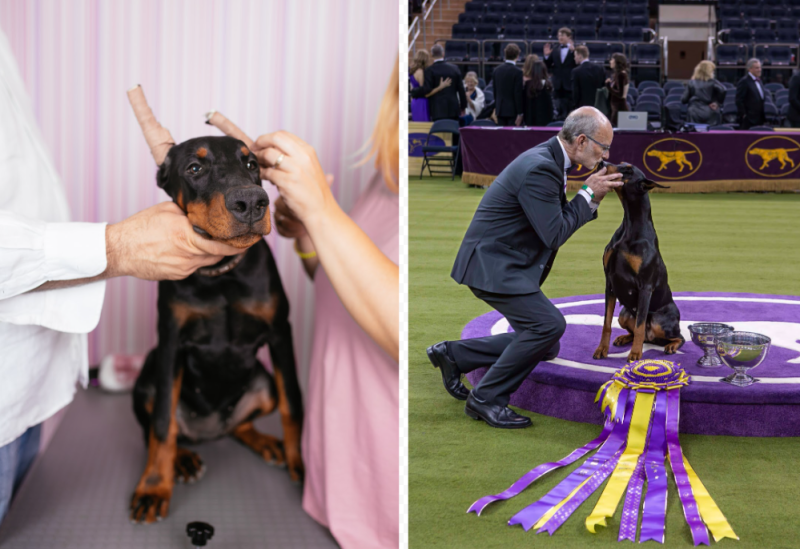
After three days of competition, a 4-year-old female Doberman, Connquest Best Of Both Worlds, aka “Penny,” beat out 2,500 dogs to take home the crown of ‘Best in Show’ at the 150th Westminster Kennel Club Dog Show. While the announcement was met with cheers and thunderous applause around the arena, it has drawn criticism worldwide for the way in which the surgically altered Doberman breed standard is not only normalized in the United States but also celebrated. So much so that many people don’t even realize that the so-called characteristic upright ears and short tail are not natural Doberman traits.
The origins of the Doberman Pinscher lie with Karl Friedrich Louis Dobermann, a German tax collector, night watchman, dogcatcher, and keeper of a dog pound, in the late 19th century. Thought to be a cocktail of Rottweiler, German Pinscher, Black and Tan Terriers, Weimaraner, and short-haired shepherds, the Doberman was first registered with the American Kennel Club (AKC) in 1908.1 Although the resultant dog ticked most of his desired boxes, he was unable to achieve his vision of a more intimidating beast with naturally pricked-up ears through breeding alone, and so the ears were cut.
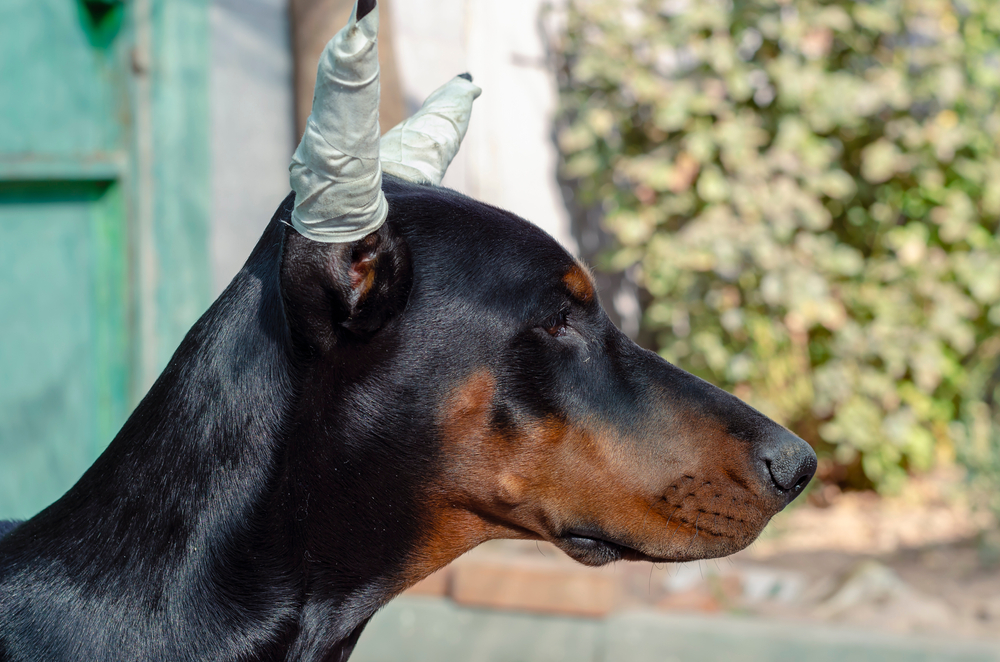
How Did Ear Cropping Start?
Although the exact origins of ear cropping are difficult to ascertain, it is believed that the practice of removing part of the ear flap or pinna may have been an attempt to tackle ear infections. If you’ve ever had a dog that suffers from chronic otitis, you would know how challenging this condition can be to manage with modern medicine, let alone without the aid of the antibiotics and antifungals we have today.2 Presumably, it was noted that dogs that had undergone this rather extreme procedure appeared more menacing, more appealing, and were less susceptible to torn ears when thrown into dog-fighting rings. And so, the procedure of ear cropping became more widely accepted and encouraged, making its way into the breed standards of numerous dogs, including the Doberman, Great Dane, Boxer, and Cane Corso.

Coupled with the stern appearance of a docked tail, the ‘Doberman’s look’ is based largely on a fantasy of an intimidating, stoic, and alert guard dog. In reality, as most Doberman lovers will tell you, these dogs tend to be affectionate, loyal, and occasionally highly strung; not exactly the traits of a fearsome attack beast! Unfortunately, the ‘breed standard’ is often seen as biblical in stature, the authority of which cannot be challenged or altered. Despite being written within the last 120 years, the idea of making alterations to the dogma seems to be outrageous to Doberman devotees, while making alterations to the dog itself is, rather ironically, perfectly acceptable.

Despite a century of docking and cropping, the majority of Europe, including the UK, Australia, and New Zealand have completely outlawed ear cropping and limited tail docking, and with new laws being introduced in the only outlier, Ontario, ear cropping will soon be illegal in all of Canada. Unsurprisingly, the kennel clubs of these countries updated their breed standards to match, proving that it can be done.
Kennel Clubs Need To Do Better
The Westminster Kennel Club, established in 1877, is America’s oldest organization dedicated to the sport of dogs; even older than the American Kennel Club, which dates back to 1884. The emphasis on conformation is a point of pride for the club, whose standards many dog breeders and owners dream of meeting. With so much influence over the canine community, the Westminster Kennel Club, along with all kennel clubs, has a responsibility to set standards that are in the best interests of the health and welfare of the dogs, and this is simply not the case.

By giving top honors to a dog whose natural features have been mutilated in order to conform to some perceived version of perfection, the Westminster Kennel Club has, in no uncertain terms, indicated that they continue to put appearances before welfare. The dog-loving community looks to the authority of these organizations, and the example they have set is disappointingly outdated.
We contacted Westminster Kennel Club to hear what they thought about the backlash over awarding a docked & cropped dog Best in Show, and how that decision aligns with their mission to “enhance the lives of all dogs, celebrate the companionship of dogs, promote responsible dog ownership, and breed preservation.”
At the time of writing, we have not received a response.
So it would appear that the kennel clubs of America are not in any hurry to join the rest of the world in eradicating elective surgical mutilation of dogs for the purposes of aesthetics, but that doesn’t mean we should simply accept this position. Change starts with education, and helping those who have been misinformed to understand that ear cropping is a wholly unnecessary and entirely aesthetic procedure is how we can bring about that change. Surgically altering an animal to suit our preferences simply shouldn’t be happening in this modern age, and using ‘breed standard’ as justification makes no sense when such standards can be rewritten.
Feature Image Credit: DuxX & Westminster Kennel Club, Shutterstock
Did You Know?
- Our breaking news articles are included in our weekly emails. Don’t miss out on the latest and sign up for our newsletter below!
make it easy to read for teens.Organize the content with appropriate headings and subheadings (h1, h2, h3, h4, h5, h6) and made content unique. Include conclusion section and do not include the title. it must return only article i dont want any extra information or introductory text with article e.g: ” Here is rewritten article:” or “Here is the rewritten content:”